

NEWS

Social-Emotional Learning and Play Intersecting
Socio-dramatic play holds immense potential for nurturing emotional intelligence.
Singing and performing are also a part of socio-dramatic play.
Socio-dramatic play holds immense potential for nurturing emotional intelligence. This form of play, in particular, proves to be both dynamic and immersive for children to explore and understand their own and others’ emotions. This form of play involves role-playing and imaginative scenarios, which allow children to identify, experience, and express a wide range of emotions when an environment is safe and supportive.
Children take on different roles in the socio-dramatic play and experience a rich emotional landscape. Children encounter various emotions firsthand by pretending to be teachers, doctors, or parents, and they develop the ability to recognize and communicate feelings authentically. This process cultivates emotional literacy as children learn to label emotions and understand their causes and consequences. This type of play connects body and mind.
Empathy and world-traveling are also nurtured through socio-dramatic play. By playing different roles and interacting with peers, children gain insights into the emotional experiences of others. They learn to interpret non-verbal cues and facial expressions, fostering empathy and understanding of a multitude of emotions.
Embracing socio-dramatic play and emphasizing emotional identification empowers children to navigate the complexities of emotions with confidence and empathy. By providing many opportunities for socio-dramatic play, we equip children with lifelong skills to build harmonious relationships with themselves and others in the real world.
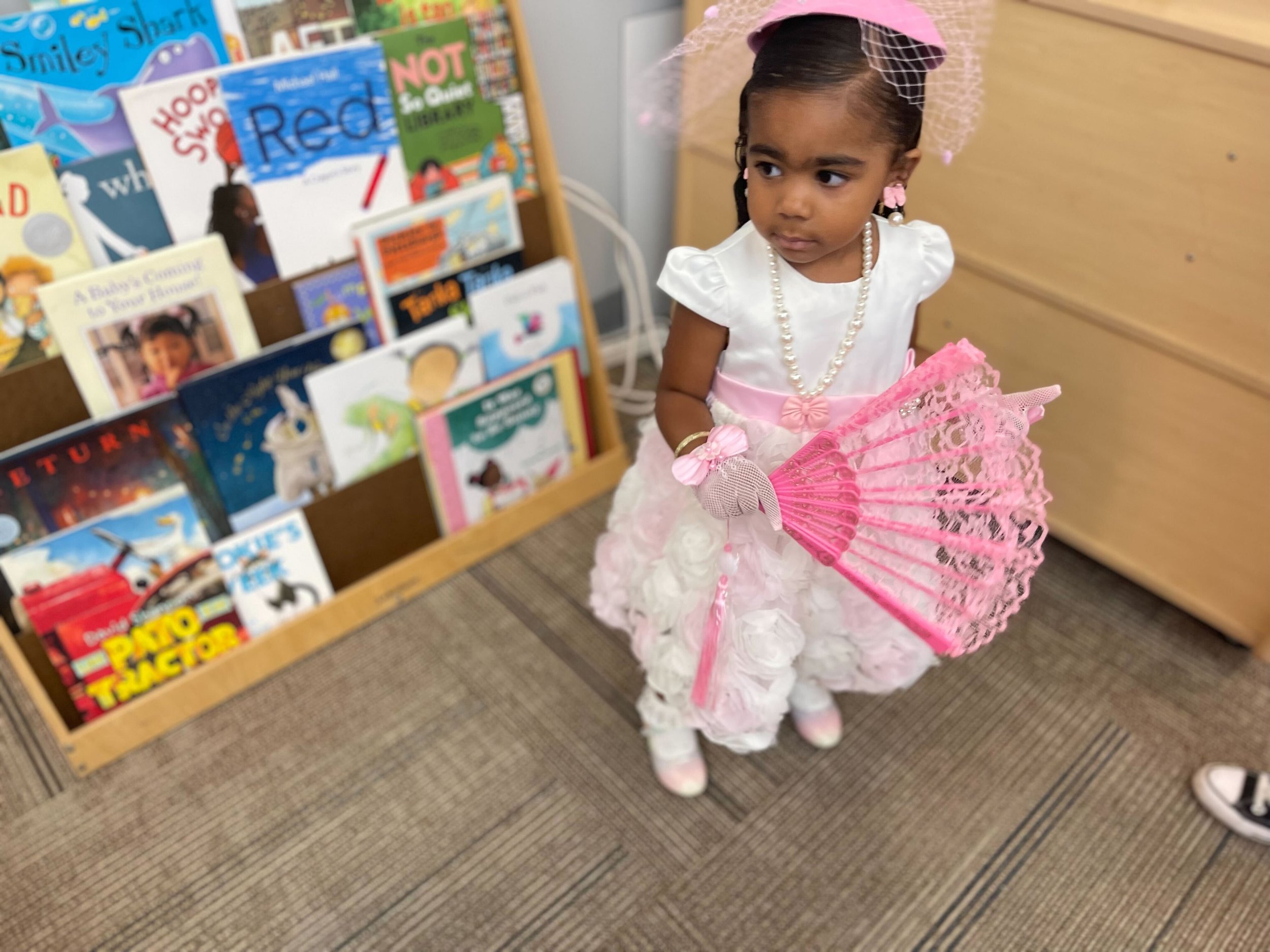
You child demonstrates socio-dramatic play and pretend play during a “tea party” story time at The Homewood Early Learning Hub & Family Center.
DAP Action Step: You can implement socio-dramatic play with your family by encouraging socio-dramatic play at home, in classrooms, or within your local community setting. Provide loose parts like props, costumes, and other open-ended materials that inspire imaginative play. Engage children in conversations about emotions, helping them identify and understand their feelings and those of others. By supporting socio-dramatic play, we enable children to develop emotional intelligence and prepare them for the world they’ll soon be navigating.

How Bluey Showcases Play, Creativity, and Emotional Learning for Children...and Adults
If you are a parent, grandparent, or caregiver, you have more than likely heard of the animated, family entertainment phenomenon that is "Bluey". But what has made the cartoon so memorable and impactful?
Sisters Bluey and Bingo from the television show, Bluey.
If you are a parent, grandparent, or caregiver, you have more than likely heard of the animated, family entertainment phenomenon that is "Bluey." With the upcoming “Bluey’s Big Play” live program taking place in Pittsburgh during September, the fandom for the play-focused canines continues to trend upwards. But what has made the cartoon so memorable and impactful?
For most families and caregivers, the way in which the show advocates for play and creativity, mixed with heart-tugging storylines, makes the show a “must watch” for all ages.
Bluey Helps Teach Children and Parents About Play and Creativity
Simply, adults and kids love this Australian animated show. The program mainly focuses on a family of blue heeler dogs living in Brisbane. While the episodes themselves are only seven minutes long, the show illustrates the beauty of childhood and focuses on the realities of being a parent in current times.
The animated program features 6-year-old Bluey; her 4-year-old sister, Bingo; her mom, Chili; and her dad, Bandit.
The show exemplifies what years of child psychology research have made clear: that children learn through play. Bluey illustrates a variety of age-appropriate caregiving practices that parents and caregivers can use in the everyday life of a child. There are even certain episodes or scenes that provide inspiration for playful learning opportunities for all families.
Check out a list of playful learning lessons highlighted by The 74, a nonprofit news organization covering America’s education system.
What are parents and caregivers learning from “Bluey?”
From lessons about why personal self care is important to lessons about accepting and moving on from failure, Bluey’s storylines have shown to be empathetic, insightful, and most important of all, emotional.
During a recent NPR segment, parents of children whom are fans of the show shared why Bluey has been impactful in navigating the everyday, real life issues and complications that come into
During the episode “Grandad,” a senior family member needs a medical procedure (heartworm surgery) and rest. While the children want to get outside and play with their energetic granddad, the mother, Chili, harks on why her father should be resting, but ultimately learns that time is fleeting and childhood deserves attention. Chili reminisces on her own playful experience with her caregiver, giving some perspective in the minds of adults from this unexpected, educational source.
This is one of many examples of how Bluey incorporates social-emotional learning into relatable scenarios for all ages, and particularly for adults.
Check out a list of 12 life lessons that adults can learn from the show from ScreenRant.
Bluey’s Big Play, September 23 and 24, Pittsburgh, Pa.
If you’re in the City of Pittsburgh, you’ll have an opportunity to check out the live show, “Bluey’s Big Play” on September 23 and 24. The live program takes audience members through a Sunday afternoon in the Heeler household where Dad (Bandit) feels like a little bit of afternoon time out, while children Bluey and Bingo have other plans for their day.
Learn more about “Bluey’s Big Play” from the Pittsburgh Cultural Trust

Let’s Talk Loose Parts Play
The natural world is full with loose parts! Learn more about loose parts play and its benefits from Playful Pittsburgh Collaborative assistant director, Adam James Zahren.
The natural world is full with loose parts!
When I was younger, we’d play kitchen outside by smashing up berries, mud, and grass and mixing it all together. Then, we’d set our rock table with big green leaves and puffy snowball-like hydrangeas. We’d imagine we were at a fancy restaurant, say “excusez-moi” as if we were French, and laugh the afternoon away.
In the same afternoon, we’d use sticks as scythes and knock down tall grasses before building our fort out of the logs and sticks we’d find in the surrounding area. In the outside world, anything can become a loose part. Anything can be used to craft a playful world for yourself, and for others!
What is Loose Parts Play, and Why is it Beneficial?
Loose parts places the power in the hands of the player. When using loose parts, individuals build a world of their own, leverage their imaginations to fill in gaps and collaborate with those around them to invent together. It’s sort of like the Stone Soup story: everyone brings a bit of something to the table, and when it’s all said and done, there’s a beautiful feast for the imagination waiting in the mud and muck.

Don’t forget to attend the “IPA-USA National Day of Loose Parts Play” event on Saturday, September 16. (Scan the QR code for more information).
If you love getting outside and exploring nature, check out these Park Activities from our partners at Pittsburgh Parks Conservancy. There are many ways of exploring nature and creating something along the way.
How can you use loose parts to tell a story? Can you use them to create a picture? The world is yours with loose parts play!
Loose Parts Play Resources
[WATCH] Rusty's Backyard - Loose Parts, Rusty Keeler YouTube
“Loose Parts” in Children’s Outdoor Play Environments Resources, International Journal of Early Childhood Environmental Education
Playful Possibilities: Simple Cardboard Box More Than it Seems to Young Learners, Omaha Wolrd-Herald
Loose Parts Play in Preschool: A Guide for Educators and Parents, brightwheel
When Kids Like the Box More Than the Toy: The Benefits of Playing with Everyday Objects, The Conversation

Join us for an International Day of Play!
Playful Pittsburgh Collaborative is teaming up with local organizations, as well as the national organization IPA-USA, to bring a memorable play day to Lytle Land on Saturday, September 16, 2023.

Save the date and mark your calendars for a special, pop-up play day on September 16, 2023!
Autumn is about to kick off, which means school is back in session, the sun sinks below the horizon sooner, and the leaves begin transforming before our eyes. But just because so many things are changing doesn’t mean that the importance of play or being playful has shifted. The transformative power of play can benefit anyone at any age, all year long.
Playful Pittsburgh Collaborative is teaming up with local organizations like Child in Mind Consulting, Lion of Judah Enterprises, City Squeakers, and Kaleidoscope Pittsburgh as well as the national Organization IPA-USA, to bring a memorable play day to Lytle Land on Saturday, September 16, 2023.
IPA-USA is the United States chapter of the International Play Association. The International Play Association supported the Declaration of the Rights of the Child and was formed in 1961 in Denmark. IPA-USA was formed in 1973 in Philadelphia. However, the United States has still not ratified this declaration. Playful Pittsburgh Collaborative supports Article 31 and the Child’s Right to Play. We are excited to be part of the first annual play day, and we look forward to continuing to advocate for play, its importance, and the ways it benefits the livelihood of children and adults.
During this event, you will be able to participate in loose parts play activities for people of all ages. Loose parts can unlock creativity and help us explore new ways of seeing and thinking about the world around us. Loose parts are great for developing motor skills and gaining spatial awareness. With loose parts play, there is no set list of rules, and the possibilities of imagining are nearly endless. Our community partners are bringing something fun and engaging that you will surely love.
On top of loose parts play activities from community partners, there’s a Kaboom! playground on-site at Lytle Land with equipment like a slide, a tunnel teeter-totter, and a log walk.
There are fun opportunities for the whole family at this event to celebrate play! Can’t wait to see you there!
Event Details: IPA-USA National Day of Loose Parts Play
When: Saturday, 9/16 | 10 a.m. – 1 p.m.
Where: Lytle Land Park, 5113 Lytle Street, Pittsburgh, Pa. 15207 (Hazelwood)
Light snacks and refreshments will be provided. We know you’ll leave the play day feeling inspired and creative, so the fun can continue wherever your family travels! Loose parts are all around us!
Don’t miss this celebration of play from perspectives around the world!
The Story Behind Intergenerational Play
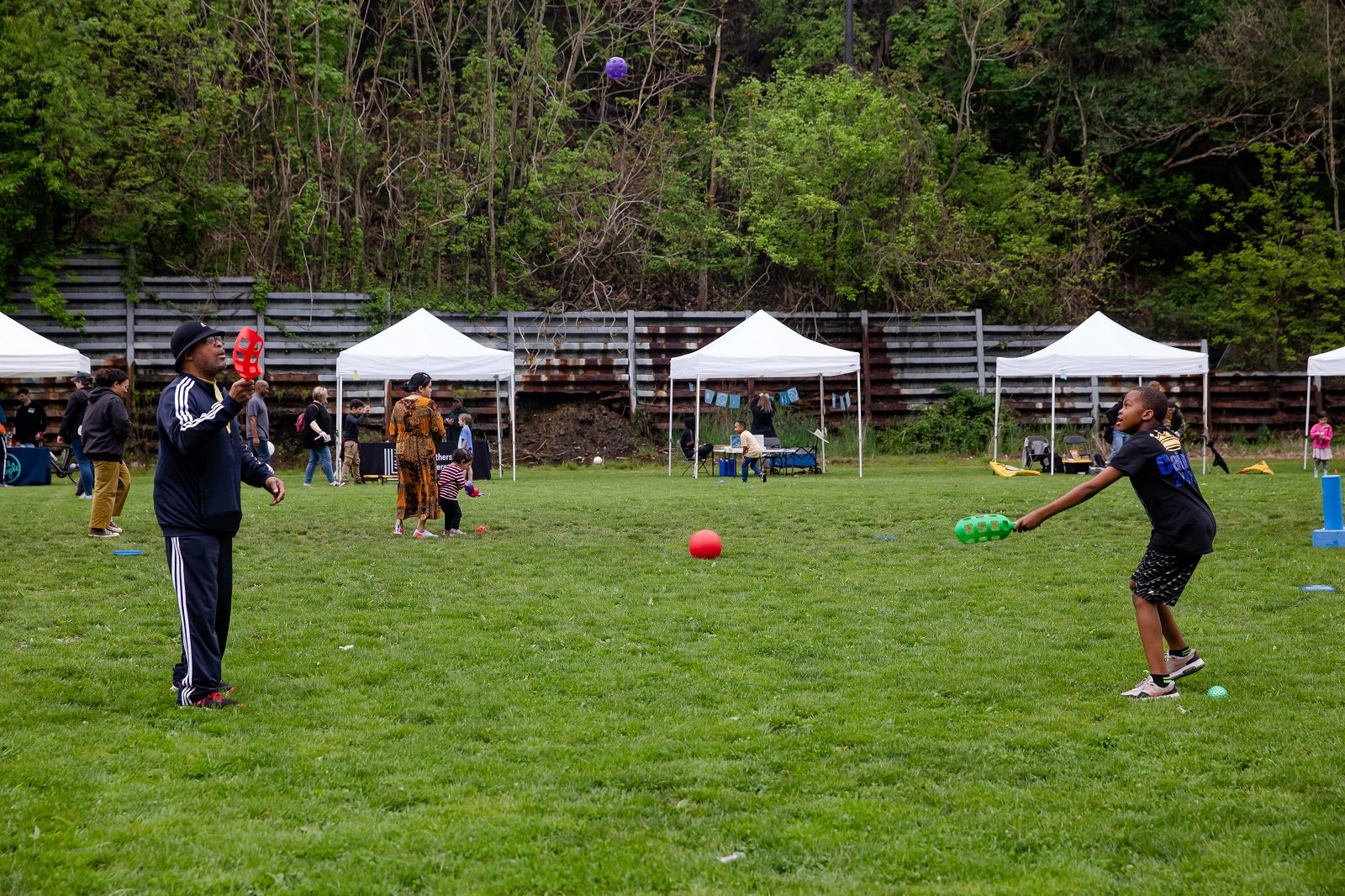
Through intergenerational play, adults and children can further their social bonds, develop lifelong skills like language cognition and problem-solving together, and discover more of the world around them.
The term intergenerational is often defined as a purposeful, regular exchange and learning between children and older people. This intergenerational sharing can bridge generational differences and provide mutual benefits, as well as counteract ageism and age-related stereotypes.

Photo Credit: Crystal Joy Photography
Why Intergenerational Play and Recreation is Important
As Irish playwright George Bernard Shaw famously said, “We don’t stop playing because we grow older; we grow older because we stop playing.” Play is not only beneficial but essential for people of all ages. Today, there is increasing interest in the benefits of not only play itself, but specifically people from younger and older generations playing together.
Research shows that play is essentially good for older adults: it promotes relaxation, reduces stress, and helps to maintain cognitive skills, such as memory and problem-solving. Active play for older adults helps to increase muscle tone, coordination, and reaction time. Adults who exercise regularly can significantly reduce the risk of developing dementia and Alzheimer’s disease. Intergenerational play is also the ideal setting for the family to bond with each other.
Older adults and children can engage together in numerous types of play, and no specific type of play is more beneficial than another. For example, ‘make-believe’ is one form of play where adults can, if they choose, effortlessly influence the development of a child’s social and moral values, through encouraging co-operation, honesty, and good sportsmanship. Generations can learn more about language development by playing with each other as it can help to improve social and communication skills.
Activities that are generally associated with intergenerational play can include puzzles, construction or building sets like stackable bricks and blocks, drawing, board games, arts and crafts, and story-telling. These activities help socially to develop bonds between adult and child, but also encourage imagination and sense of achievement.
Conclusion
Children can gain a lot when older adults take an active role in play. Children who play with older adults demonstrate more creativity and higher levels of language and problem-solving skills. For older adults, play has many psychological and health benefits, particularly when children are involved.
Through intergenerational play, older adults and children can further their social bonds, develop lifelong skills like language cognition and problem-solving together, and discover more of the world around them.

Photo Credit: Crystal Joy Photography

Play is a Lifelong Game
Adults often do not play nearly enough, but with the right intention, adults can begin to bring more play into their lives life.
Adults often do not play nearly enough, but with the right intention, adults can begin to bring more play into their lives.

Photo Credit: Crystal Joy Photography
Benefits of Engaging in Play as an Adult
Engaging in playful activities is crucial for adults' growth and stress reduction. Play promotes creativity, problem-solving, and cognitive flexibility, enabling adults to explore new ideas and experiment with different perspectives. Additionally, play is a form of self-care, providing a break from daily stressors and promoting mental and emotional well-being by fostering relaxation.
When adults engage in play, they help establish social bonds and reinforce community ties, and can improve their communications skills, empathy, and teamwork. Participating in group events and games fosters a sense of camaraderie, trust, and cooperation among participants. This type of interaction can dissolve barriers, promote inclusivity, and facilitate positive communication.
Play is also a respected field of scientific study for adults. The scientific understanding of play helps professionals design interventions, workshops, and training programs that harness the power of play to enhance adult development and well-being.
The Formal Operational Stage
The formal operational stage takes places from around 11 or 12 years old through adulthood, according to Jean Piaget’s Theory of Play.
During the beginning of the formal operational stage, individuals begin to understand abstract thought and can manipulate ideas in their heads.
They will also be able to do more complicated math and think creatively, and they can understand more complicated scientific ideas. They also can understand hypothetical scenarios and questions.
According to Piaget’s theory, once individuals reach the formal operational stage, they have attained the highest level of cognitive development, as defined by his model. However, this does not suggest a cognitive plateau.
Cognitive development is individual and influenced by a range of factors beyond mere biological maturation. The nature of human cognition always makes room for refinement, growth, and development throughout adulthood.
Furthermore, individual competence can vary greatly within the formal operational stage. For instance, a person might employ formal operational thinking in one area of life (such as their job) but not others.
Similarly, skills like problem-solving, logical reasoning, and handling abstract concepts can continue to improve with practice and experience.
Playful activities that help individuals to develop during the formal operational stage can include:
Rubik’s cubes
Chess
Games that involve strategy and thought
Sudoku puzzles
A multitude of books on different subjects
Taking classes on hobbies and deep-diving into hobbies
Conclusion
In conclusion, play is not limited to childhood and also tremendously benefits adults. It fuels personal growth, promotes social connections, and contributes to well-being. By embracing play, adults can tap into their creativity, reduce stress, and strengthen relationships. Additionally, the scientific study of play for adults provides valuable insights that inform professionals in diverse fields. Recognizing the importance of play throughout adulthood enables individuals and communities to thrive and lead fulfilling lives.
Resources about Play and Adults
Here are some additional resources to further explore the impact of play for adults:
Making Play Part of Adult Life, The National Institute for Play
How to Reclaim Your Playful Self and Find More Joy, Psychology Today
Adults can Find Joy Through Play, too, CNNHealth
Successful Aging: The Importance of Play for Stress Relief and Brain Function, Los Angeles Daily News
Plenty of Sleep, Healthy Meals and Exercise are Part of your Routine. What’s Missing?, CNNHealth

Photo Credit: Crystal Joy Photography